Filter by
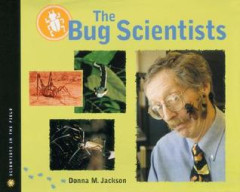
The bug scientists
Small is beautiful—or so the bug scientists of the world believe. Insects, they say, boast qualities the rest of us have perhaps overlooked. They are among the earth’s best fliers and farmers. They have survived and adapted for 350 million years, whereas we humans have been around for a mere 10,000 years. There are millions upon millions of species yet to be identified. Indeed, insects are …
- Edition
- -
- ISBN/ISSN
- 9780618432325
- Collation
- 48 pages : illustration ; 22 cm
- Series Title
- -
- Call Number
- 595.7 JAC
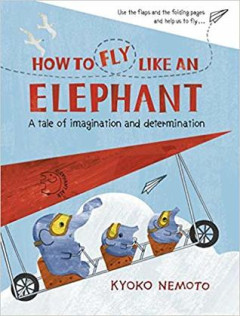
How to fly like an elephant : a tale of imagination and determination
Everyone knows elephants can't fly: they're too heavy, and they have no wings! But what happens when three elephants work together to design a flying machine? How to Fly Like an Elephant combines an introduction to design and engineering with a story about persistence and teamwork. Featuring interactive folding elements and flaps, the elephants will need YOUR help to finally get off the ground.
- Edition
- -
- ISBN/ISSN
- 9780141388403
- Collation
- 32 pages : illustration ; 28 cm
- Series Title
- -
- Call Number
- N

From tadpole to frog
Winner of the American Association for the Advancement of Science/Subaru Science Books & Films Prize for Outstanding Science Series A tadpole is a baby frog! Female frogs lay masses of jelly-coated eggs in the water, but what hatches from each egg isn't a frog yet—it's a tadpole. Tadpoles are likely tiny fish that breathe underwater through gills. As the tadpole gets older, it loses its…
- Edition
- -
- ISBN/ISSN
- 0439454654
- Collation
- 32 pages : illustration ; 20 cm
- Series Title
- Lest-read-and-find-out science
- Call Number
- 597.8 PFE
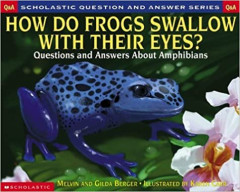
How do frogs swallow with their eyes? : questions and answers about amphibians
From basic questions like, "Do amphibians have ears?" to more involved ones such as "What is an amphibian's best defense?", this title provides answers for even the most inquisitive of young minds. How do frogs swallow with their eyes? Easily. When swallowing a big mouthful of food, a frog blinks its eyes. The blinking pushes the frogs huge eyeballs down on top of its mouth. This helps sque…
- Edition
- -
- ISBN/ISSN
- 9780439266772
- Collation
- 48 pages : illustration ; 20 cm
- Series Title
- Scholastic question and answer series
- Call Number
- 597.8 BER
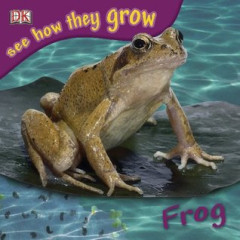
See how the grow : frog
Written in story form, this text shows how an egg grows into a tadpole, and then into a leaping frog. It is part of a series which charts the early stages of an animal's life.
- Edition
- -
- ISBN/ISSN
- 9781428740976
- Collation
- 24 pages : illustration ; 20 cm
- Series Title
- -
- Call Number
- 597.8 ROY

Tree frogs
Text and photographs introduce the physical characteristics and behavior of tree frogs that live in tropical rain forests.
- Edition
- -
- ISBN/ISSN
- 9780736896108
- Collation
- 24 pages : illustration ; 17 cm
- Series Title
- -
- Call Number
- 597.8 FRO
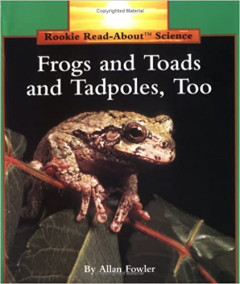
Frogs and toads, and tadpoles, too
What's the difference between a frog and a toad? The natural world comes alive for young readers (Ages 6-7) with Rookie Read-About "RM" Science! With striking, full-color photos and just the right amount of text, this series immediately involves young readers as they discover intriguing facts about the fascinating world around them.This book discusses the likenesses and differences between fro…
- Edition
- -
- ISBN/ISSN
- 9780516449258
- Collation
- 31 pages : illustration ; 17 cm
- Series Title
- Read about science
- Call Number
- 597.8 FOW

Butterflies
This rhyming easy-to-read non-fiction science reader covers a favorite nature subject taught in the early childhood curriculum -- the metamorphosis of a caterpillar to a butterfly. "Butterflies start as tiny eggs. Out come caterpillars with many legs...." With catchy rhyming text, author Karen Shapiro gives readers a very simple lesson in the process of metamorphosis from caterpillar to b…
- Edition
- -
- ISBN/ISSN
- 9780439206365
- Collation
- 31 pages : illustration ; 22 cm
- Series Title
- Scholastic readers : Level 2
- Call Number
- 595.7 SHA

Fantastic frogs!
Young readers will enjoy learning how frogs grow, what they eat, where they live, and the many colors and shapes they come in.
- Edition
- -
- ISBN/ISSN
- 9780590522694
- Collation
- 32 pages : illustration ; 22 cm
- Series Title
- Scholastic reader : Level 2
- Call Number
- 597.8 ROB

The bugliest bug
All of insect land is abuzz with news of a big contest! The demure Damselfly Dilly - "neither clever nor frilly" - has no thoughts of winning, but she’s curious to find out who will. And what she sees makes her eyes bug out! Glowworms light up the stage, the audience hums with anticipation, and a panel of judges grins . . . but wait, aren’t those fangs she sees glinting? The wild and wit…
- Edition
- -
- ISBN/ISSN
- 0439437873
- Collation
- 32 pages : illustration ; 22 cm
- Series Title
- -
- Call Number
- 595.7 SHI
 Computer Science, Information & General Works
  Philosophy & Psychology
  Religion
  Social Sciences
  Language
  Pure Science
  Applied Sciences
  Art & Recreation
  Literature
  History & Geography